





Microwave Communication Tower
Self-supporting steel lattice towers designed to support microwave antennas for telecommunication applications, available in height options from 5 to 200 meters
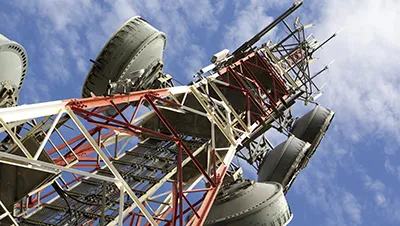
Microwave communication towers are steel structures used to support microwave antennas for long-distance wireless signal transmission. These communication masts are widely used in telecommunications and broadcasting networks to keep point-to-point microwave links stable for data, radio, and other wireless signals.
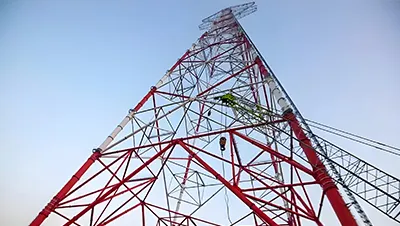
These self-supporting steel lattice towers are usually installed on open land, building rooftops, or mountain tops, depending on coverage needs. The supporting structures are built to handle strong wind conditions and are commonly made from angle steel, steel plates, or full tubular steel sections. All structural components are connected with bolts and treated with hot-dip galvanizing after fabrication to protect them from corrosion and extend their service life.
- Design Standard ANSI/TIA-222-G / H / F; EN 1991-1-4; EN 1993-3-1
- Height Range 5–200 m
- Design Wind Speed Up to 300 km/h (according to project requirements)
- Surface Treatment Hot-dip galvanized; Painting
- Structural Design
- Specifications
- Features
- Project
- Manufacturing
- Tower Structure
Most tower structures are built with steel angle sections, steel pipes, and their height is typically set between 15 and 150 meters according to the specific project requirements. - Antenna Platforms
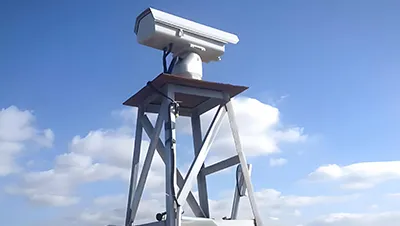
Dedicated platforms are used to install parabolic antennas, flat panel antennas, and other microwave communication equipment. - Lightning Protection System
Lightning rods are installed at the top of the towers, and the entire structure is properly grounded to protect against lightning strikes.
Typical Installation Environments
Microwave towers are designed for long-distance transmission, so they are suitable for mountainous areas, islands, and other locations with complex terrain.
| Product | Telecommunication tower |
| Tower Type | Self-Supporting Tower |
| Ice Thickness | 5–10 mm (varies by region) |
| Seismic Resistance | Up to 8° seismic intensity |
| Operating Temperature Range | –45°C to +45°C |
| Vertical Deviation | ≤ 1/1000 |
| Material Supplier | Baosteel / Shougang Steel / Hansteel / Tangsteel |
| Design Standard | ANSI/TIA-222-G / H / F; EN 1991-1-4; EN 1993-3-1 |
| Certification | ISO 9001: 2015; COC; Third Party Inspection Report (SGS, BV) |
| Bolts & Fasteners | Grade 8.8 / 6.8 / 4.8; ASTM A325; DIN 7990, DIN 931, DIN 933; ISO 4032, ISO 4034 |
| Main Material | Angular steel or tubular steel |
| Height Range | 5–200 m |
| Design Wind Speed | Up to 300 km/h (according to project requirements) |
| Surface Treatment | Hot-dip galvanized; Painting |
| Galvanizing Standard | ASTM A123 / ISO 1461 |
| Service Life | More than 20 years |
| Color | Silver (galvanized) or painted (RAL color standard), customized |
| Installation Method | Ground-mounted, rooftop installations, and slope installations |
| Certification Standard | ||
| Design Standards |
|
|
| Structural Steel | ||
| Grade | Mild Steel | High Tensile Steel |
| GB/T 700 – Q235B, Q235C, Q235D | GB/T 1591 – Q355B, Q355C, Q355D, Q420B | |
| ASTM A36 | ASTM A572 Gr.50 | |
| EN 10025 – S235JR, S235J0, S235J2 | EN 10025 – S355JR, S355J0, S355J2 | |
| Design Wind Speed | Up to 300 km/h | |
| Allowable deflection | 0.5–1.0° @ operational speed | |
| Tensile strength (MPa) | 360–510 | 470–630 |
| Yield strength (t ≤ 16 mm) (MPa) | 235 | 355 / 420 |
| Elongation (%) | 20 | 24 |
| Impact strength KV (J) | 27 (20°C) - Q235B (S235JR) | 27 (20°C) - Q355B (S355JR) |
| 27 (0°C) - Q235C (S235J0) | 27 (0°C) - Q355C (S355J0) | |
| 27 (-20°C) - Q235D (S235J2) | 27 (-20°C) - Q355D (S355J2) | |
| Bolts & Nuts | ||
| Grade | Grade 4.8, 6.8, 8.8 | |
| Standards for mechanical properties | ||
| Bolts | ISO 898-1 | |
| Nuts | ISO 898-2 | |
| Washers | ISO 7089 / DIN 125 / DIN 9021 | |
| Standards for dimensions | ||
| Bolts (dimensions) | DIN 7990, DIN 931, DIN 933 | |
| Nuts (dimensions) | ISO 4032, ISO 4034 | |
| Washers (dimensions) | DIN 7989, DIN 127B, ISO 7091 | |
| Welding | ||
| Method | CO₂ Shielded Arc Welding & Submerged Arc Welding (SAW) | |
| Standard | AWS D1.1 | |
| Galvanizing | ||
| Galvanization standard of steel sections | ISO 1461 or ASTM A123/A123M | |
| Galvanization standard of bolts and nuts | ISO 1461 or ASTM A153/A153M | |
Main Components
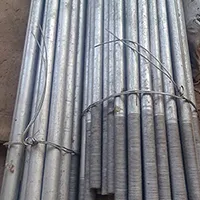 Anchor Bolts
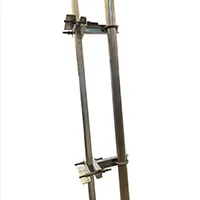 Antenna Mounting Bracket
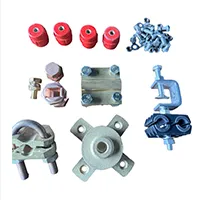 Copper Grounding Components
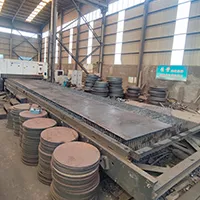 Connection Plates
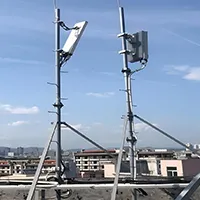 Antenna Mast
Optional Components
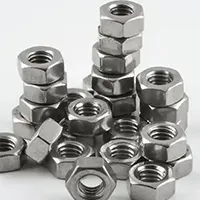 Communication Tower Bolts
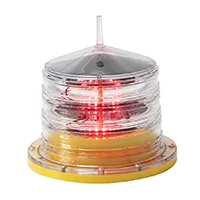 Aviation Obstruction Light
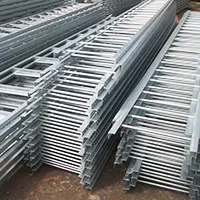 Climbing Ladder
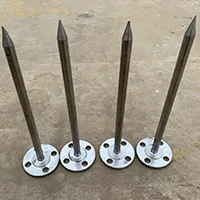 Copper Lightning Rod
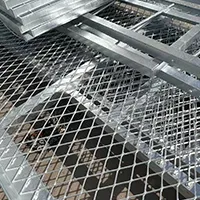 Grating Platform and Mesh Platform
We provide full technical guidance and carry out construction based on the approved drawings. If any questions arise, we are always available to assist.

When communication antennas are installed at heights of around 30–50 meters, microwave signals are able to travel much farther. Under normal operating conditions, the signal coverage range can extend to around 10–20 kilometers, which gives base stations a much larger coverage area and reducing signal gaps. As a result, signal transmission becomes more efficient, and communication remains stable even over long distances.
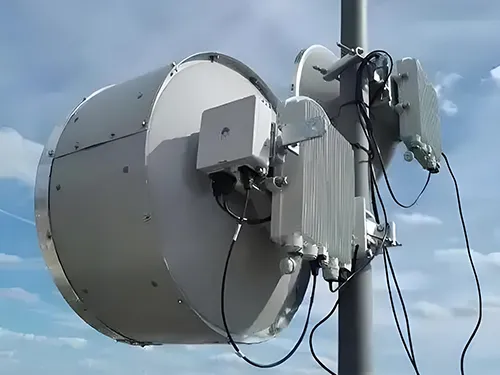
Each microwave communication tower is equipped with a lightning protection and grounding system that safely conducts lightning current from the tower to the ground. With a grounding resistance of ≤ 10 Ω, the system effectively reduces the risk of lightning damage and enhances overall operational safety.
-
 50m Microwave Communication Tower
 -
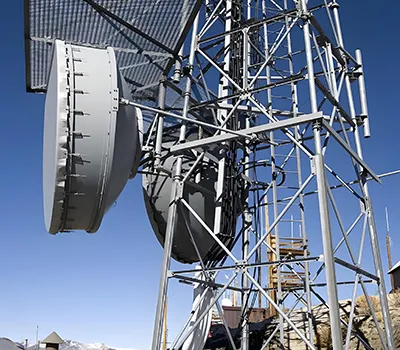 60m Microwave Communication Tower
 -
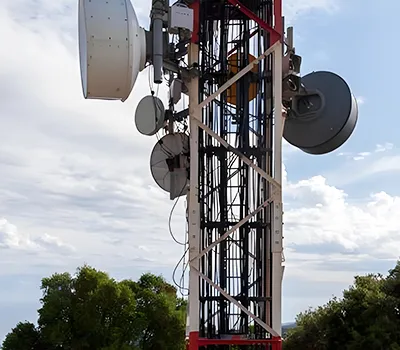 55m Microwave Communication Tower


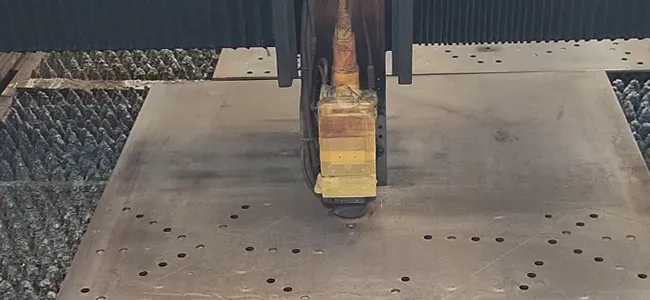
Laser Cutting
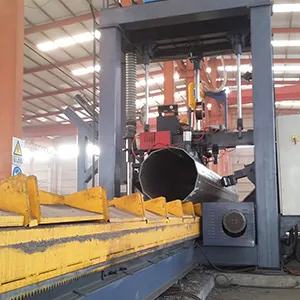
Laser cutting is used to shape the steel components through focused beam cutting and assisted gas removal. The process offers fast cutting speed and high dimensional accuracy (up to ±0.05 mm), while keeping heat impact to a minimum. This reduces the risk of deformation and results in clean, well-defined edges.
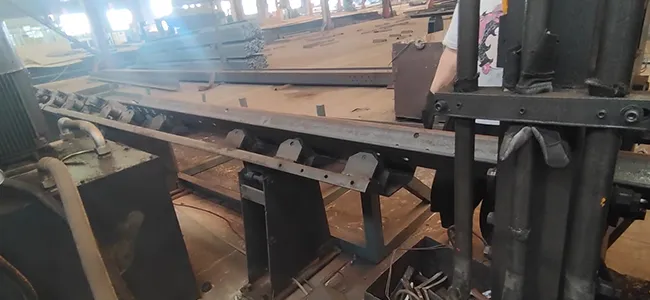
CNC Punching and Shearing
Steel angles are processed through CNC-controlled punching and shearing lines. Automatic feeding, positioning, punching, and cutting are all integrated into the process, keeping production running smoothly and efficiently. Precise CNC positioning keeps quality consistent, even when working with more complex parts.
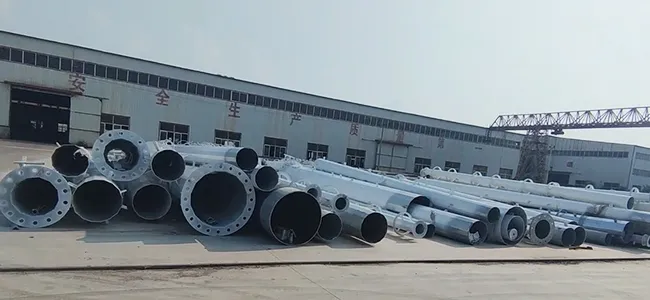
Hot-Dip Galvanizing and Surface Protection
The tower is protected with hot-dip galvanizing as the main anti-corrosion treatment, along with an extra plastic coating for added protection. The zinc layer protects the steel from rust and adds strength, while the coating gives extra insulation and surface protection. This combined treatment allows the tower to maintain reliable performance for over 20 years and adapt well to harsh environments such as high and low temperatures, coastal areas, and mountainous regions.
We also offer FRP antenna radomes and a wide range of accessories for telecommunication towers.